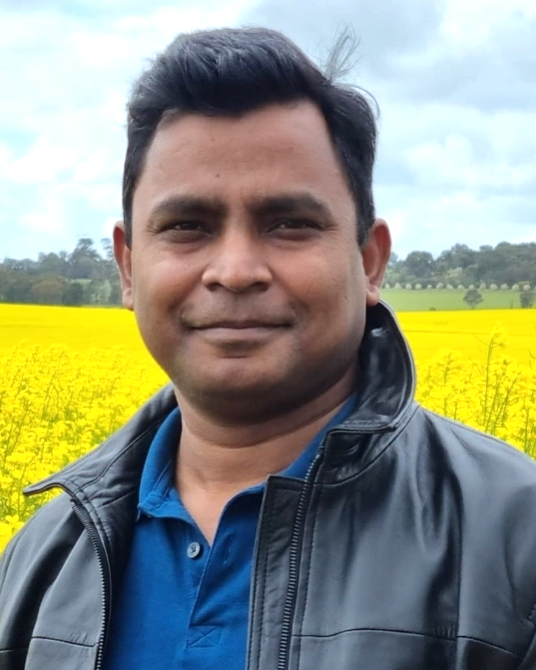
Dr. Asad (Md) Asaduzzaman, organizer of R-Mob, the R user group at Charles Sturt University (CSU), Australia, recently spoke with the R Consortium about strengthening R capacity in agricultural and environmental research through community-driven learning. He shared how R-Mob brings together researchers and students to apply R to real-world agronomic and ecological challenges. Dr. Asad discussed integrating R into agricultural education, building inclusive R communities, and using statistical modeling and machine learning to support data-driven decision-making in modern agriculture.
Can you share what the R community is like in Australia?

The R community in Australia is highly active, diverse, and collaborative, encompassing academia, government, industry, and the private tech sector. Researchers and professionals in fields such as agriculture, ecology, health, economics, and IT increasingly rely on R due to its open-source nature, strong community support, and rapid innovation through various packages.
In Australia, there is also cross-pollination of ideas between IT professionals and applied scientists. While R faces competition from other platforms for machine learning and large-scale data processing, it remains particularly strong in areas such as statistical rigor, transparency, and reproducibility, which are crucial in research and policy-making contexts. Additionally, from an educational perspective, R’s ability to integrate analysis, visualization, and reporting (such as R Markdown) makes it especially effective for teaching and for communicating results to non-technical audiences, including students and industry stakeholders.
What topics are receiving a good response in your group? What do you hope to cover in 2026?
The strongest engagement within our R-Mob group has focused on practical, immediately applicable topics. These include data visualization, data summarization and cleaning (specifically workflows for handling real, messy datasets), statistical modeling related to agriculture and ecology (such as linear mixed models and generalized linear models), and reproducible research workflows (using R Markdown and Quarto for theses, reports, and papers). These subjects resonate with members because they can be directly applied to their research projects.
Looking ahead to 2026, I plan to expand our focus to include machine learning in R for agriculture, ecological and environmental data analysis, spatial analysis and mapping (integrating R with GIS-based decision-making), time series analysis, and climate-related studies. Additionally, I aim to develop inclusive and accessible R teaching approaches, especially for students from non-programming backgrounds and diverse cultural contexts.
The goal is to gradually help users progress from confidence to competence and ultimately to leadership within the R ecosystem.
How do I Build an R User Group?
R Consortium’s R User Group and Small Conference Support Program (RUGS) provides grants to help R groups organize, share information, and support each other worldwide. We have given grants over the past four years, encompassing over 82,000 members in almost 100 user groups in 41 countries. We would like to include you! Cash grants and meetup.com accounts are awarded based on the intended use of the funds and the amount of money available to distribute