This article is cross-posted on rOpenSci and Bioconductor blogs.
For more than two decades, the Bioconductor project has been a cornerstone of the R ecosystem, providing high-quality, peer-reviewed tools for bioinformatics and computational biology. Its curated repository model, rigorous review standards, and tightly coordinated release process have helped establish Bioconductor as one of the most trusted distribution channels in scientific computing.
However, the infrastructure that supports such a long-standing and large-scale project inevitably accumulates technical debt. Legacy build systems, bespoke tooling, and historically grown workflows add up to costly and unsustainable maintenance work. For this reason, Bioconductor is collaborating with R-universe to gradually modernize parts of its infrastructure, while accommodating the project’s scale, governance, and established processes. In turn, Bioconductor is helping R-universe expand and refine its features as we learn to serve the complex needs of the Bioconductor community.
This collaboration reflects a core principle of R-universe as an R Consortium Infrastructure Steering Committee (ISC) top-level project: supporting reviewed package repositories such as rOpenSci and Bioconductor, and providing modern, open, and reusable infrastructure that strengthens the broader R ecosystem.
Two Universes: Release and Development
Bioconductor maintains two distinct repositories:
- A release branch for stable packages
- A devel branch for ongoing development and the next release cycle
To mirror this structure, we currently operate two dedicated R-universe instances:
- Development branch: https://bioc.r-universe.dev
- Release branch: https://bioc-release.r-universe.dev
These universes integrate directly with Bioconductor’s existing Git infrastructure and provide continuous builds for packages in both branches.
Through the R-universe dashboard, package maintainers and users can:
- Inspect cross-platform check results
- Review extended BiocCheck diagnostics
- Monitor build logs and dependency graphs
- Explore rich package metadata and metrics
- Publish binary packages for Windows, macOS, and Linux
This provides a familiar yet modern interface for Bioconductor contributors, aligned with what users increasingly expect from contemporary R package infrastructure.
Information about each package is available on https://bioc.r-universe.dev/{pkgname}. For example, https://bioc.r-universe.dev/DESeq2 provides details on the DESeq2 package as shown below:
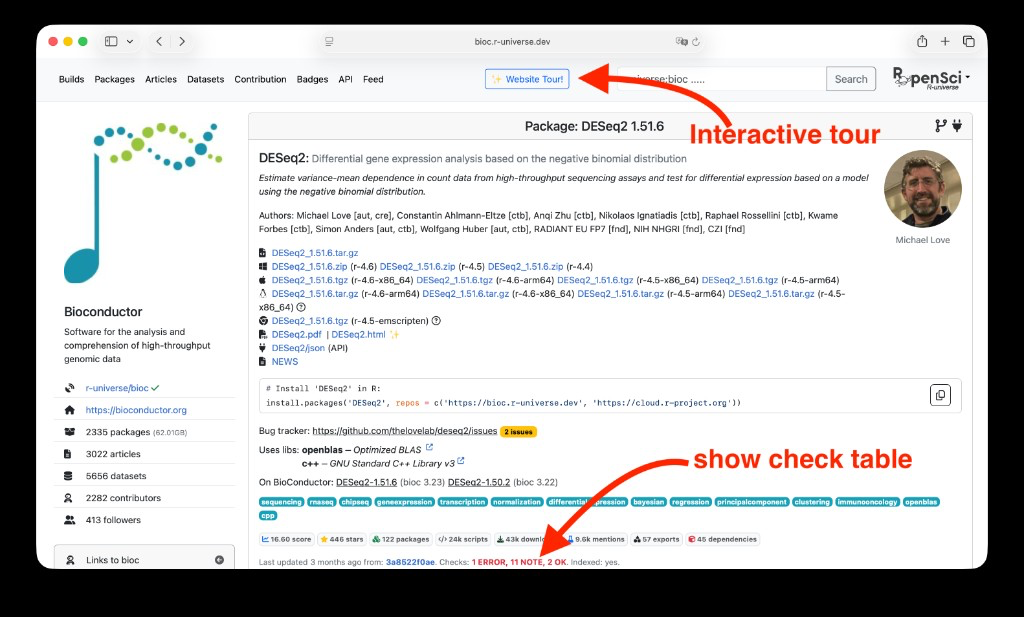
If this is your first time visiting R-universe, we recommend clicking the “Website Tour” button which will walk you through the most important information in 1 or 2 minutes.
Technical Documentation for Bioconductor Maintainers
The R-universe project maintains comprehensive technical documentation at https://docs.r-universe.dev. For Bioconductor specifically, we created a dedicated section summarizing the most relevant topics for developers to get started with R-universe: https://docs.r-universe.dev/bioconductor/
As the collaboration evolves and new components get introduced, the documentation will continue to be expanded. The goal is to provide Bioconductor maintainers with a clear reference point for understanding how R-universe fits into their development workflow, while maintaining compatibility with the established practices that have made Bioconductor a successful project within the R community.
Looking Ahead
Adopting new infrastructure inevitably involves adjustments. For Bioconductor developers, integrating with a new build and distribution system will likely require some changes to workflows, and time to become familiar with new or different package checks, build diagnostics, and binary distribution.
However, by gradually moving toward common infrastructure, the Bioconductor project will benefit from improvements that are being continuously developed and maintained for the broader R ecosystem. A system based on modern continuous integration (CI) will provide developers with improved tooling, and will give the core team more time to focus on community coordination and quality control, rather than on maintaining costly infrastructure. At the same time, the shared platform provided by R-universe can help to increase the visibility and accessibility of Bioconductor software to the greater R community.
We look forward to continuing this alliance and to working with the Bioconductor community to ensure that the next generation of infrastructure supports the project for many years to come.